
The GST Council at its next meeting may consider a reduction in taxes on air and water purifiers as air quality across the country worsens and access to safe drinking water remains uneven.

Any reduction on purifiers would need consensus among state finance ministers.
The Goods and Services Tax (GST) Council, scheduled to meet on June 22, could take a call on ending uncertainty on taxing foreign airlines and shippers as regards certain services, a senior official in the know told Business Standard. He said the Council was expected to decide on exempting the services in question from GST - aircraft lease rentals, maintenance, crew salaries, etc. These services are provided by foreign airlines to their Indian operations.

The Delhi High Court has directed the GST Council to consider lowering or abolishing the goods and services tax on air purifiers, citing worsening air quality in the national capital. The court has asked the council to meet at the earliest, even via video conference if necessary, to address the issue.
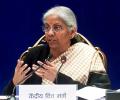
The GST Council on Saturday postponed a decision on cutting tax rate on life and health insurance premiums, officials said. The 55th meeting of the GST Council, chaired by Union Finance Minister Nirmala Sitharaman and comprising state counterparts, decided that some more technicalities needed to be ironed out and tasked the GoM for further deliberations.

The October 5 meeting assumes significance as the Centre and states are at loggerheads over the issue of funding Rs 2.35 lakh crore GST collection shortfall.
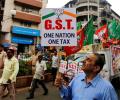
The 41st meeting of the GST Council, to be held via video conferencing, has just one agenda for discussion -- making up for shortfall in states' revenues, sources said.

Reaching a consensus might also get tougher, as already seen with issues like inclusion of natural gas in GST and imposition of a sugar cess, both central proposals being resisted.
It is likely to be a stormy affair with divergent views on market borrowing. Centre will likely press states to borrow to make up for the shortfall, but states want either the Centre or the GST Council to do so.

Since the legal changes in the draft laws would take some time, it was decided to postpone the November 25 meeting

While Congress and the states ruled by non-NDA parties pushed for the Centre meeting its statutory obligation of covering the deficit, the Union government cited a legal opinion to say it had no such obligation if there was a shortfall in tax collections. The Centre as well as BJP-JD-U-ruled Bihar were of the opinion that the states should borrow to make up for the shortfall in the tax revenues that have been compounded by the COVID-19 crisis, sources said.
The GST Council, chaired by Finance Minister Nirmala Sitharaman, will meet on December 31 and discuss, among other things, report of the panel of state ministers on rate rationalisation. This will be a physical meeting, which will also discuss correction in duty inversion in certain goods. The 46th GST Council meeting will be held on December 31 in Delhi, an official said, adding that it will be an extension to the pre-budget meeting with state finance ministers on December 30. The Group of Ministers (GoM) on rate rationalisation will submit report to the Council.

Some states are taking a legal view on the state GST rate and the compensation rules ahead of the Goods and Services Tax (GST) Council meeting, which is likely to be held in mid-June, said people in the know. While the agenda is still being finalised, several states are likely to take up the matter related to GST compensation and may pitch for its continuation beyond the June 30 deadline. States would like to know how they would divide the compensation collected after June 2022 for payment of principal and interest of compensation shortfall borrowing and arrears to states, sources said.

In order to reduce government litigations, the Union Finance Minister Nirmala Sitharaman on Saturday said the GST Council has fixed a monetary limit for filing appeals by the tax department before the various appellate authorities. It has recommended a monetary limit of Rs 20 lakh for GST Appellate Tribunal, Rs 1 crore for the High Court and Rs 2 crore for the Supreme Court for filing of appeals by the department before these legal forums, she said after the 53rd GST Council meeting held in New Delhi.

Ahead of the first meeting of the top decision-making body in nearly eight months, finance ministers of eight states ruled by non-Bharatiya Janata Party and like-minded parties -- Rajasthan, Punjab, Chhattisgarh, Tamil Nadu, Maharashtra, Jharkhand, Kerala and West Bengal -- have devised a joint strategy to press for a zero tax rate on Covid essentials, sources said.

The GST Council, in its meeting on Saturday, is likely to decide on reducing tax rates on life and health insurance premiums, while hiking it on high-end wrist watches, shoes and apparels, besides considering a separate 35 per cent tax slab for sin goods. The 55th meeting of the GST Council, chaired by Union Finance Minister Nirmala Sitharaman and comprising state counterparts, is likely to discuss rate rejig in about 148 items, besides, it will also deliberate on bringing Aviation Turbine Fuel (ATF), a major component for airline industry's operation cost, in the Goods and Services Tax (GST) fold.

It will also be new Revenue Secretary Sanjay Malhotra's first GST Council meeting. He will take charge after the incumbent Tarun Bajaj retires on November 30.
The Goods and Services Tax (GST) Council, which is likely to meet in the third or fourth week of June, is set to clear the operational framework of the much-awaited GST appellate tribunal, which will deal with tax disputes and streamline resolution. "The final blueprint, mainly the operational part, is expected to be presented in the GST Council meeting for approval. "This will pave the way for the tribunal to be functional, both at the central and state levels," said a senior government official, who expects the tribunal to be up and running by November.
The GST Council on Saturday clarified that guarantees provided by corporate to their subsidiaries will attract an 18 per cent GST, while no tax will be levied if a personal guarantee is given by a director to the company. The council, chaired by Union Finance Minister Nirmala Sitharaman and comprising state ministers, also cut the GST rate on molasses to 5 per cent from 28 per cent. It also ceded the right to tax Extra Neutral Alcohol (raw product for making alcohol for human consumption) to the states.

The fitment committee under the Goods and Services Tax (GST) Council, comprising central and state officials, has begun a rate rationalisation exercise afresh, checking the possibility of dropping some of the rates, particularly the 12 per cent slab, to achieve a revenue-neutral structure, a senior official with direct knowledge of the matter

The GST Council's agenda includes trimming the number of items in the 28 per cent slab by 75 per cent, easier compliance for assessees and small taxpayers, and a presentation on bringing real estate under GST.

Petroleum Minister Dharmendra Pradhan's wish to levy indirect tax on petrol unlikely to be taken up

Inching towards rolling out of GST, the GST Council on Saturday approved a law to compensate states for any loss of revenue from the implementation of the new national sales tax but deferred approval for enabling laws to next meeting.

As cess levied under GST isn't shared by states, most states oppose it on the ground that it would set a wrong precedent and distort the GST structure.
The Centre is looking to convene a meeting of the all-powerful Goods and Service Tax Council in early January. The meeting is likely to focus on rectifying the inverted duty structure for a few more items and will also serve as a platform for pre-Budget discussions between Union Finance Minister Nirmala Sitharaman and state finance ministers, Business Standard has learnt. "The current Winter Session of Parliament ends on December 23, followed by the Christmas-New Year period. "After that we would like to have a meeting of the GST Council, depending on whether there can be a quorum," a top government official said.

The Supreme Court on Thursday ruled that the Goods and Service Tax (GST) Council's recommendations are not binding on Union and State but have a persuasive value as the country has a cooperative federal structure.

Opposition-ruled states warn of steep annual losses; Centre assures higher consumption will offset revenue hit.

The Delhi High Court has asked the central government why it cannot reduce the GST on air purifiers, considering the poor air quality in Delhi. The court's concern is that the current 18% GST makes air purifiers unaffordable for the common man.
The GST Council in its meeting next week is likely to consider a proposal for making changes in the monthly tax payment form -- GSTR-3B, which would include auto-population of outward supplies from sales return and non-editable tax payment table, officials said. The move would help curb the menace of fake billing, whereby sellers would show higher sales in GSTR-1 to enable purchasers to claim input tax credit (ITC), but report suppressed sales in GSTR-3B to lower GST liability. Currently, GSTR-3B of a taxpayer includes auto drafted input tax credit (ITC) statements based on inward and outward B2B supplies and also red flags any mismatch between GSTR-1 and 3B.
With a view to keeping inflation under check, essential items including food, which presently constitute roughly half of the consumer inflation basket, will be taxed at zero rate.

The 47th GST Council meeting that is currently underway is slated to discuss a host of issues, including a mechanism for compensating states for revenue loss, tax rate tweaks in some items and relaxed registration norms for small online suppliers. Further, the meeting of the Council, chaired by the Union Finance Minister Nirmala Sitharaman and comprising state counterparts, will also clear levying the highest tax of 28 per cent on online games, casinos and horse racing, besides, measures to curb tax evasion, especially devising ways to tackle high-risk taxpayers in GST. "The meeting is being chaired by Hon'ble Union Minister of Finance @nsitharaman and many important decisions are expected to be taken at the meet," PIB Chandigarh tweeted.

'In case a particular industry has not passed on the benefits and if we receive complaints, we will take up the matter with the industry body concerned.'

Next meeting of the Council will be on June 18, when it will take up lottery taxes and e-way bill.

The Centre has proposed exempting life and health insurance policies for individuals from GST, Bihar Deputy Chief Minister and convenor of insurance GoM Samrat Choudhary said on Wednesday. Currently, health and life insurance premium attracts 18 per cent GST.

Victory wrested from regime that only listens when forced, the TMC said on GST exemption on insurance.

Mahindra & Mahindra on Saturday said it has reduced prices of its passenger vehicle range by up to Rs 1.56 lakh with immediate effect in order to pass on GST rate cut benefit to customers. The price cut follows the announcement of revamped GST at the 56th GST Council meeting held on September 3, 2025, the Mumbai-based auto major said in a statement.

Electric vehicle (EV) manufacturers breathed a sigh of relief after the GST Council on Wednesday night retained the concessional 5 per cent rate on EVs, though they now face competition from small petrol and diesel cars, which will attract a lower 18 per cent levy.

The focus will be on tackling the unfinished agenda requiring immediate attention like tax structure for solar projects, uniform tax rate on state-organised and state-authorised lotteries, taxing non-potable alcohol besides certain changes in the law, extension for NAA and rate rationalisation.

Among Sensex firms, Tata Steel jumped the most by 5.90 per cent. Titan, Mahindra & Mahindra, ITC, Eternal, State Bank of India, and Trent were among the other gainers. However, Infosys, NTPC, Hindustan Unilever, TCS, Adani Ports and Bharti Airtel were among the laggards.

'It must become faceless, just as the entire direct tax assessment system has already become fully online, without any human intervention in the normal course,' recommends A K Bhattacharya.
 © 2026 Rediff.com - Advertise with us - Disclaimer - Privacy Policy - Sitemap - Feedback - About us - Terms of use - Grievances